The Unit That Pays Its Own Rent: Writing Self-Storage as an American Reliquary
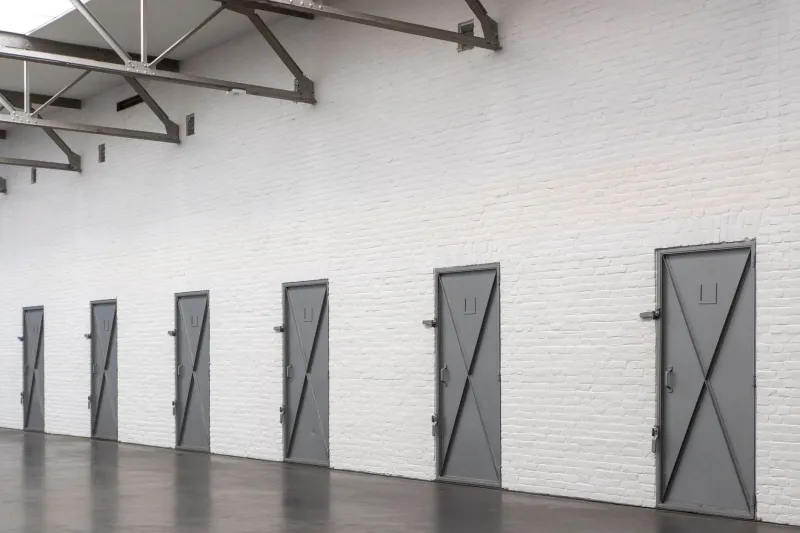
At 9:40 on a Tuesday night, the gate code still works. The keypad glows a tired green, the chain-link rolls back, and the lot opens like a held breath. Rows of roll-up doors catch the headlights and give nothing back. Somewhere above, a security lamp hums. Somewhere inside, a dehumidifier ticks through its cycle for no one. This is the self-storage facility as America has built it: not a warehouse, not quite a cemetery, but a monthly subscription to postponement.
The Liturgy of the Gate Code
We do not talk about storage units the way we talk about attics or basements, and that is part of their power. The attic is domestic. It belongs to the house, and its ghosts are family ghosts. The storage facility is industrial and anonymous, leased by the month, entered through a code that feels less like a key and more like a password to a room that should not exist. The corridor is climate controlled. The light is always on. The door is numbered. The whole place is designed to make forgetting feel responsible.
For the horror writer, this is a gift. The storage facility offers a liminal space that is also a bureaucracy. It has rules, invoices, late fees, auction notices. It has the terrible politeness of institutions. A haunting here does not need cobwebs. It needs a ledger.
A Reliquary With a Monthly Bill
Americans rent storage units for reasons that are rarely about storage. They rent them because the house sold faster than the grief did. Because the apartment is too small for the dining table that belonged to a grandmother no one liked. Because the divorce papers said split the contents, and splitting is not the same as deciding. The unit becomes a reliquary of postponed decisions, and the monthly bill becomes a small, bearable ritual of not deciding again.
This is the cultural engine of the subgenre. The horror is not that something is locked away. The horror is that the locking away has become a habit, and the habit has become a payment, and the payment has become a kind of love. A storage unit is a promise that the past can be kept at arm's length and still remain yours. The story begins when the arm begins to tire.
The Architecture of Postponement
Write the facility with precision, not atmosphere alone. The fluorescent light should be specific: the slight flicker at the end of the row, the way it turns skin the color of old paper. The roll-up door should have a sound, but resist the easy comparison. It is not a scream. It is closer to a throat clearing, a metal cough, a noise that announces a body without confirming one. The concrete floor should hold dust in the corners and a faint chemical sweetness from the last tenant's mattress. The air should be cool, dry, and strangely clean.
Climate control is a craft detail with philosophical weight. It implies care. Someone is paying to keep the temperature stable. Someone is preserving the contents. That care can be tender or obscene, depending on what is inside. A unit that is climate controlled and never opened is a contradiction the reader will feel before they can name it. Use that contradiction. Let the reader wonder who benefits from preservation when no one visits.
Inventory as Confession
The inventory is where the story hides. A storage unit is a list, and every list is a confession. Do not describe the unit as a vague mass of boxes. Choose five objects and make them argue with one another. A christening gown. A box of tax returns. A treadmill. A deer rifle. A plastic bin labeled Christmas. The combinations are endless and each one is a small biography of avoidance.
The horror of inventory is not the number of things. It is the intimacy of the things. A storage unit knows what you could not throw away. It knows which objects you could not keep close. That is a different kind of nakedness. When you write the inventory, write it as a character would notice it: by category, by shame, by the object that makes them stand still.
The Ethics of the Locked Door
The locked door is a promise and a threat. The craft question is not whether to open it, but how long the story can bear to wait. Too often, the storage-unit horror rushes to the reveal, as if the unit were a piñata of trauma. The better story understands that the locked door is an ethical pressure. The reader wants in. The character wants to leave. The narrative should make both desires feel reasonable.
Use the locked door to establish rules. Who has the key? Who has the code? Who pays the bill? What happens at auction? What does the lease say about abandonment? Bureaucratic language is a wonderful instrument of dread because it is so calm. A clause about default and disposal can be more frightening than a growl. The horror lives in the gap between the legal definition of abandoned property and the emotional fact of a kept thing.
When the Unit Begins to Pay
The premise that makes the subgenre sing is simple: the thing you stored starts paying its own rent. This is not a monster with claws. It is an administrative miracle. The invoice clears. The late fee disappears. The unit remains locked, but the account is current. The horror is not that something escaped. The horror is that something stayed, and it has learned the system.
Write this development with restraint. Do not explain the mechanism. Let the evidence accumulate: a payment confirmation, a changed contact email, a voicemail that is only breathing and a dial tone. The uncanny here is procedural. The facility is not haunted by a ghost; it is haunted by a tenant who has become a policy. That inversion is distinctly modern and distinctly American. We understand a monthly bill better than we understand a demon.
The Ending That Refuses to Empty
A storage-unit story should not end with an empty unit unless the emptiness is the horror. The genre's best endings leave the door open on a space that is neither full nor vacant. The lease is paid through next month. The key is still in the character's pocket. The inventory is one object shorter, or one object longer, and no one can say which. The reader closes the story with the sensation of having signed something.
That is the final craft note. Do not ask the reader to fear the dark corridor. Ask them to recognize the corridor. We all have a unit somewhere, literal or otherwise, and we all know the small relief of paying to keep it shut. The horror story simply sends someone back to check on it after hours, when the gate code still works and the light is still on and the thing inside has begun to look after itself.