Beneath the Sodium Lamps: What the Highway Remembers After Midnight
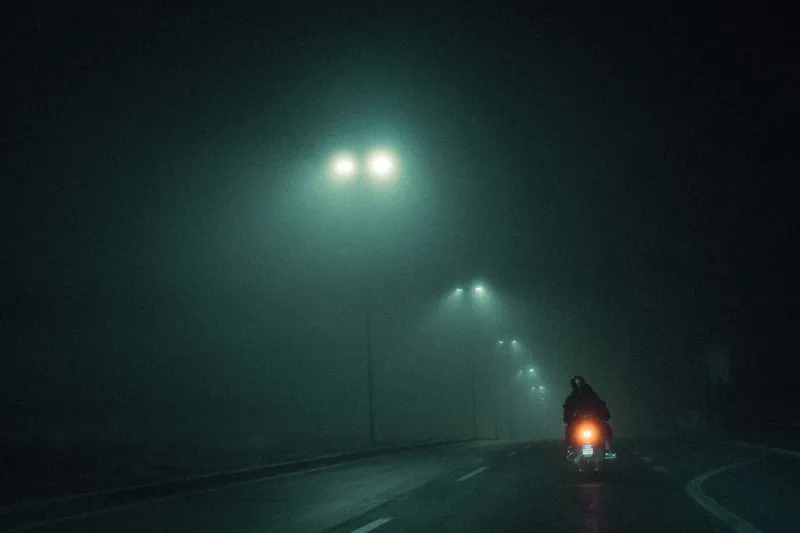
There is a particular hour on the American interstate when the road stops pretending to be infrastructure. Somewhere past midnight, between the sodium lamps that pool orange light every hundred yards and the long black intervals between them, the highway becomes a story being told to itself. Ask anyone who has driven it — long-haul truckers, night nurses, the man who fuels your car at 3 a.m. in Amarillo — and they will lower their voices before they answer.
The Road as Oral Archive
America has always kept its strangest folklore on wheels. The phantom hitchhiker of Route 66, picked up and lost twice in the same rain. The vanishing hitchhiker of Interstate 84 outside Boise, remembered by drivers who never met each other. The trucker on CB Channel 19 who warns of an accident ahead — one that dispatch cannot confirm, and that the state patrol never logged.
These are not ghost stories in the parlor sense. They are testimony. The highway is the last genuinely oral landscape in the country, a place where stories are passed driver to driver, radio crackle to radio crackle, unburdened by the internet's habit of explaining things. A rest stop bulletin board in Wyoming functions much like a village well did in older centuries: a place where the strange is posted, pinned, and left for the next traveler to decide about.
What gives road folklore its particular weight is the road's own history. Interstates were carved through cemeteries, homesteads, and forgotten town sites. When a highway in Ohio bends for no engineering reason, locals will tell you whose land it swerved to avoid — or whose grave it refused to disturb. The asphalt is a palimpsest. Under the lane paint, something older is still legible.
The Night Shift Knows
If you want the unvarnished version, you do not ask a folklorist. You ask the people who work the hours the rest of the country sleeps through.
A toll booth operator in western Pennsylvania described to us the same sedan passing her window four times in one night, each driver a stranger, each plate from a state she couldn't place on a map. A weigh station clerk outside El Paso spoke of a voice on the CB that gave mile markers for exits that had been decommissioned decades ago. None of these accounts ends with an explanation. That is the signature of true road lore: it simply stops, like headlights sweeping past.
There is a discipline to listening to these stories. They are not evidence of anything, and they do not want to be. They are the night shift's way of marking the hours — a folklore of the working dead, told by people keeping watch so the rest of us can sleep.
A Testimony, Taken Down
The following fragment arrived in our mailbox from a reader who asked to be identified only by her first initial. We reprint it with her permission, lightly edited for length.
The overpass outside Salina, Kansas. I'd driven it a hundred times. This time the fog sat on the road like it had been poured there. My radio lost the station and picked up something else — a man reading numbers, slow, like a ledger. Mile markers, maybe. I passed under the bridge and the fog didn't touch my windshield. When I checked the mirror, the road behind me was dry. All the way back to the horizon, dry. I have not driven that stretch at night since, and I have never told anyone why until now.
We offer no interpretation. The account stands better unexplained, the way a stone stands better unturned.
Your Turn at the Wheel
This piece is an invitation as much as an article. If you have driven the empty hours and come away with a story you've told only reluctantly — a hitchhiker who wasn't there on the second glance, a radio voice with no source, a stretch of road your family refuses after dark — we want to read it.
Send your roadside encounters to the editors at Silent Darkness. The most compelling testimonies will anchor a follow-up feature, an anthology of the unexplained assembled from the shoulders of America's highways. Names can be withheld. Details can be vague. But the road keeps its records, and so do we.
Drive carefully. And if the fog behind you is dry — perhaps keep it to yourself until you've told us first.