The Ramps That Remember: Crafting the Parking Deck as a Vertical Confessional
A Building Designed for Leaving, Built to Delay
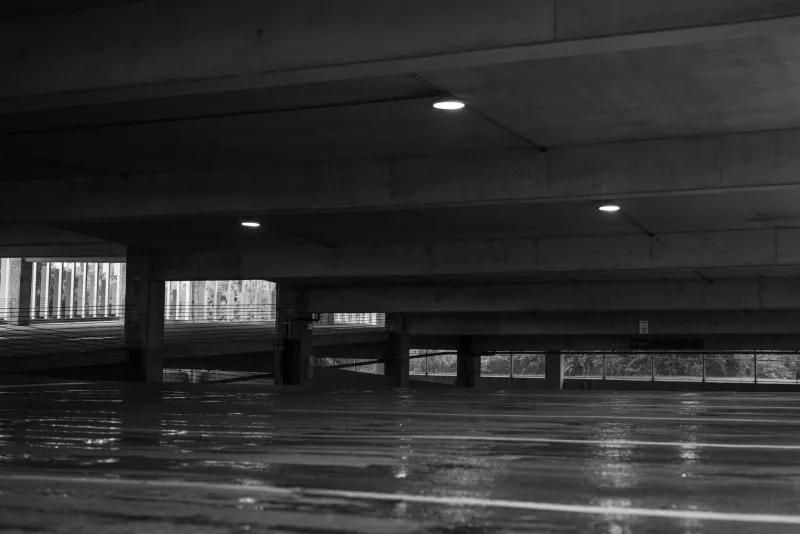
The American parking garage is rarely remembered as architecture. It is infrastructure: a downtown deck attached to a department store, a hospital structure with numbered levels, a mall garage whose ramps curl upward like a shell. We enter, we park, we walk away. Yet the parking deck lingers in the mind because it is a building designed for departure that constantly delays it. Every ramp promises an exit and delivers another turn. Every level marker—P1, P2, P3—suggests progress while the concrete looks exactly the same.
For writers of dark fiction, this is not a limitation. It is a gift. The parking garage is a vertical confessional: a space where characters are separated from the street, stripped of ordinary orientation, and made to repeat small rituals—drive, turn, park, remember, return. Unlike the motel room or the storm cellar, the deck does not offer rest or shelter. It offers circulation. Its horror is not in what is hidden behind a door but in the possibility that the door you just passed was the one you needed.
The Ramp as Litany
The ramp is the parking garage’s central rhetorical device. It is a sentence that keeps revising itself. In a downtown deck, the ascent is often spiral; in a hospital structure, it may be a long, shallow incline with speed bumps like punctuation. Either way, the ramp creates repetition without sameness. The driver sees the same concrete wall, the same painted arrow, the same oil stain, but the angle has shifted. This is the geometry of a litany—a prayer repeated until the words lose their surface meaning and become something else.
Craft note: use the ramp to measure a character’s deterioration. A first ascent can be practical, even mundane. A second can be irritable. A third can be frightened. By the fourth, the character should notice something wrong not in the garage but in the act of counting. The horror arrives when the litany becomes compulsory. The driver is no longer choosing to circle; the building is choosing for them.
Level Markers and the Illusion of Progress
Parking structures love numerals. P3, Level 2, Row C, Section Orange. These markers imply a rational order, a map that can be trusted. In fiction, they are most effective when they begin to disagree with one another. A character parks on P3, walks to the stairwell, and finds a sign for P4. Another descends two flights and emerges on the same level. The numerals remain legible; the building remains plausible. Only the relationship between them has gone wrong.
This is a subtler dread than a haunted room. It is the dread of a system that still functions but no longer means what it says. For a writer, the rule is simple: do not break the garage. Let it break its promises. The fluorescent lights can flicker, but they should still hum. The concrete can sweat, but it should still smell like concrete. The supernatural should enter through maintenance, not melodrama.
Blind Corners, Stairwell Echoes, and the Confessional Booth
The parking garage is full of partial views. Blind corners hide oncoming headlights. Concrete pillars interrupt sightlines. Stairwells carry sound upward and downward at once, so that a footstep is never clearly above or below. These are the mechanics of confession: the speaker cannot see the listener, but the listener can hear everything.
Use the stairwell as the booth. A character pauses on a landing between levels, and the echo of their own breathing returns a half-second late. Someone else is crying two floors down, or maybe one floor up. The sound is intimate and unattributed. In a garage, confession does not require a priest. It requires an enclosure, a delay, and the suspicion that someone is listening without being seen.
The Car as Congregation and Cage
Every exit in a parking garage leads back to a car. This is the space’s final cruelty. The vehicle that brought the character in becomes both witness and cage. A car in a deck is not freedom; it is a parked object among other parked objects, its windshield reflecting the same fluorescent tubes as every other windshield. When a character returns to the car and finds it exactly where they left it, the relief should be brief. The garage has not finished with them.
For pursuit scenes, the car creates a particular rhythm: short bursts of motion, long stretches of listening. The engine is off. The windows are fogged. The character watches the ramp for headlights that do not come, then come too slowly. The parking deck turns a chase into a vigil.
Writing the Deck Without Repeating the Motel
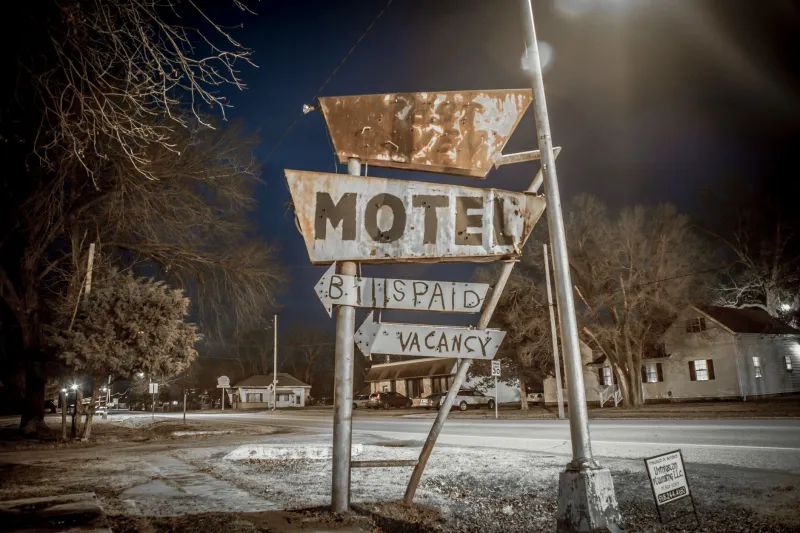
The motel is horizontal and temporary; the parking garage is vertical and circulatory. The motel offers a room; the garage offers a route. The motel’s horror is often domestic—thin walls, strange neighbors, a bed that belongs to no one. The garage’s horror is architectural—ramps that repeat, levels that misalign, stairwells that return sound without a source. Keep the distinction sharp, and the deck will not feel like a borrowed set.
A useful exercise: write a scene in which a character confesses something while circling a garage. They should not stop the car. The confession should be interrupted by a turn, a speed bump, a flickering tube. By the end, the character should have said more than they intended, and the building should have said nothing at all. That silence is the point.
A Final Turn
The American parking garage is a concrete confessional because it makes privacy public and public space private. It is a place where people cry in cars, argue in stairwells, and forget where they parked. It is also a place where the repeating ramp can become a sentence without a period. Write it with restraint. Let the numerals stay legible. Let the lights hum. Let the exit sign glow at the end of the level, and let the driver take it—only to find another ramp, another level, another chance to confess.