Fluorescent Saints and Plastic Chairs: Writing the Airport Prayer Room for the Ones Who Never Board
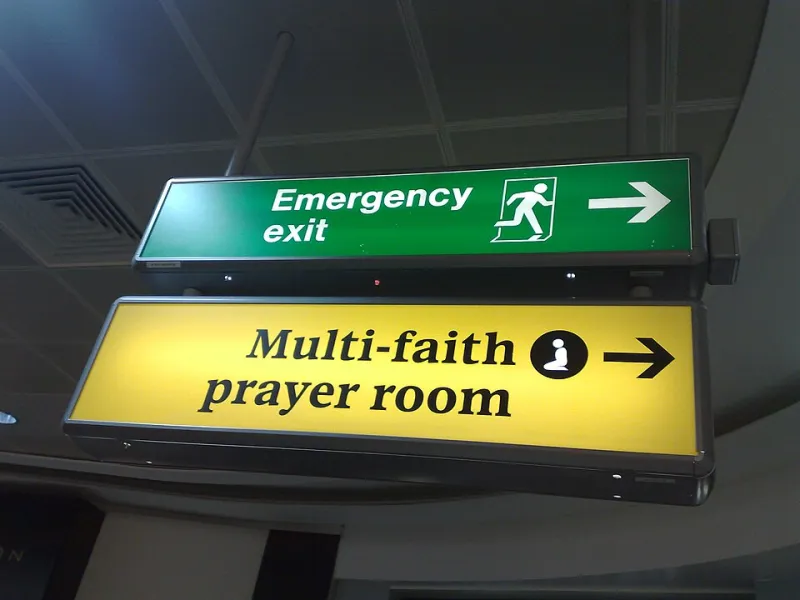
Photo: Jyri Engestrom, CC BY 2.0, via Wikimedia Commons
There is a particular kind of quiet that exists only in airports, and it is not peaceful. It is the quiet of a hundred thousand people concentrating on a schedule. It hums. It smells of carpet tile and cinnamon and the sharp mechanical breath of a jet bridge extending.
Then you pass a sign with an arrow, and the hum changes key.
The airport chapel — interfaith prayer room, meditation space, quiet room, whatever the terminal has chosen to call it this decade — is typically a windowless rectangle set between a newsstand and a gate. It holds eight to sixteen chairs. The chairs are plastic, or upholstered in a fabric chosen by committee. There is a small shelf of borrowed texts, a guest book, and, in the better ones, a card rack where travelers write petitions in ballpoint and leave them behind.
It is one of the most honest haunted spaces in America, and almost nobody writes it.
A Room With No Arrival
Airports are engineered for transit and hostile to dwelling. The chapel is the one room that admits what the rest of the terminal conceals: that all this motion is a rehearsal for an ending. You do not go there to reach somewhere. You go there to sit in the strange interim between the security checkpoint, where you were briefly treated as a suspect, and the gate, where you will be briefly treated as cargo.
That interim has a name in every faith and no name in the terminal's vocabulary. Call it the departure lounge for the dead. That is not a metaphor. It is a description of the architecture's function.
The Sacred in a Secular Shell
Notice how the room is furnished. The sacred, when it is installed in secular architecture, arrives as furniture. A folding screen indicating direction. A small stone. A plastic plant. A shelf of holy books with a laminated card asking that they be returned.
This is not mockery. It is the most American form of devotion available: the denomination of the temporary. A room that must serve everyone serves no one in particular, and that vacancy is precisely what gives it power. The chapel is nondenominational in the way an airport is nowhere. It is a room that belongs to the concept of belonging.
Craft note for writers: do not furnish your chapel with the symbols of a specific faith unless you intend to make a specific claim. Furnish it with accommodations. The stacking chair. The adjustable lighting dial. The small bin of foam earplugs someone left out of kindness.
Fluorescent Saints
The light in these rooms is almost always wrong. Too even. Too bright for grief, too green for prayer. It flattens faces. It makes a woman in a business suit and a young man in a hooded sweatshirt look equally like figures in a waiting photograph.
Use that light. Horror and grief both equalize. In the chapel, the executive and the runaway and the mother with the folded sonogram all occupy the same grade of fluorescence. There is no hierarchy in a room built for transit. There is only who is leaving and who is waiting to hear about it.
Writing Silence Without Sentimentality
The trap is reverence. A chapel scene written with reverence becomes an inspirational poster. The room does not want your awe. It wants your attention to detail.
Write the sounds instead of the silence. The gate announcement bleeding through the wall, muffled to vowels. The jet bridge's hydraulic sigh. The clicking of a phone set to silent but not silent enough. The sound of a person crying in the specific, careful way people cry in public — short, disciplined, absorbed into a cough.
Then write what does not happen. No one comes to comfort her. The prayer book is returned to the shelf unread. The petition card is filled out and left, and no one in the terminal's employ is paid to read it.
The Ones Who Never Board
Every airport has a permanent population in its stories: the travelers who bought the ticket and did not get on. The ones who stood at the window as the plane pushed back. The ones whose names were called three times and then not again.
The chapel is where they are held. Not as spirits, exactly — more as unfinished itineraries. If you want to write the room as haunted, do not bring in the dead. Bring in the ones who are still technically expected. Let your character notice, on the guest book's previous page, a name written in a hand they recognize. Let the date be today. Let the departure board outside flicker and reset.
And then let the loudspeaker call a boarding group, and let the living person stand, and let them leave the card behind on the chair — because that is what we do in sacred architecture installed inside secular shells. We leave the weight with the furnishings and we go to the gate.