The Politeness of Doors: Crafting American Thresholds That Refuse to Stay Shut
In American horror, the door is rarely just a door. It is a permission slip. It separates weather from shelter, stranger from guest, and public street from private life. That separation is never absolute, which is why the threshold remains one of the genre’s most reliable pressure points. A knock is not merely a sound. It is a request for jurisdiction. A creak is not merely a noise. It is the architecture announcing that the terms have changed.
The welcome mat is not a promise. It is a warning written in friendly type.
The Threshold as Contract
Folklore has long understood what suburban architecture only implies: entry requires consent. Vampires cannot cross without invitation. Spirits linger at the lintel. Salt, iron, brooms, and blessed chalk all mark the doorway as a place where rules might hold or fail. American homes have their own secular liturgy for this. The porch light clicks on. The peephole distorts a face into a fish-eye smear. The storm door sighs shut behind a delivery. The deadbolt turns with a sound like a sentence being passed.
These fixtures are not decorative. They are instruments of consent. Each one asks the same question in a different accent: who has the right to come in, and what happens once that right is granted?
For writers, the doorway is useful because it makes abstract danger physical. A haunting that remains on the lawn can be ignored. A haunting that has been invited inside now shares the house. The horror does not begin when the monster appears. It begins when a reasonable person performs an ordinary courtesy and the reader understands, too late, that courtesy was the trap.
Porch Lights and the Theater of Safety
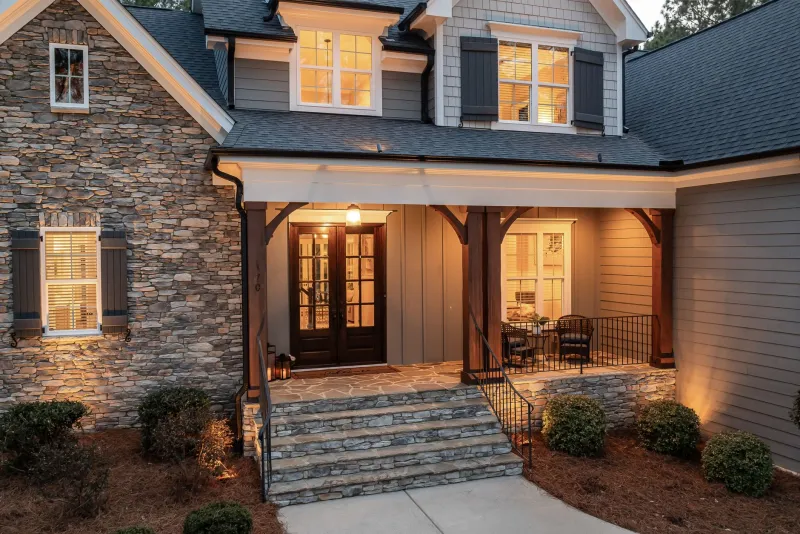
American suburbia has built an entire vocabulary of reassurance around the front door. Motion-sensor lights. Video doorbells. Deadbolts with matching keys. A lamp left on in the foyer. A car in the driveway. A welcome sign shaped like a sunflower. These are not merely objects; they are claims about the world. They say that the boundary is maintained, that the night is monitored, that the house is occupied by people who know how to keep it.
Horror works best when it does not shatter that vocabulary all at once. It edits it. The porch light comes on, but the bulb is already warm. The doorbell records a visitor, but the footage shows only a shadow with the approximate dimensions of a person. The storm door is latched from the outside, though no one in the house remembers doing it. The welcome mat has been straightened, which is worse than finding it askew.
This is the difference between a jump scare and dread. A jump scare destroys the familiar. Dread makes the familiar lie. The porch light is still doing its job. That is the problem.
Writers should resist the urge to overpopulate the threshold with monsters. A shape at the end of the walkway is less unsettling than a screen door that opens inward while the protagonist is still deciding whether to answer. The architecture should do the haunting. The door should behave as if it has opinions.
The Invitation Scene: A Craft Checklist
An intrusion scene succeeds when the reader understands the rules before the character breaks them. Establish the threshold early. Show which door is used, which lock is finicky, which light stays on, which neighbor can see the porch. Let the reader learn the house’s geography, then let the invitation violate it.
Make consent ambiguous. The most frightening invitation is not a command but a social obligation. A delivery driver needs a signature. A neighbor’s child asks to use the bathroom. A stranger claims to have the wrong address but does not leave. A voice on the other side of the door says the homeowner’s name with the patient confidence of someone who has been watching the mailbox. American politeness does the rest. The character opens the door not because they are foolish but because refusing would be rude, and rudeness feels dangerous in its own right.
Use sound before sight. The hydraulic hiss of a storm door. The rattle of a chain lock. The soft complaint of floorboards in the foyer. The click of a peephole cover sliding aside. These sounds are small, domestic, and therefore intimate. Intimacy is what makes intrusion unbearable.
Nest the thresholds. The front door is only the first. There is the mudroom, the foyer, the hallway, the kitchen doorway, the basement stairs. Each one grants a little more access. A skilled horror writer lets the intruder cross one boundary at a time, and lets the reader count.
Finally, give the door a rule and then make the rule fail. The house may be entered only by invitation. The invitation may be spoken, written, implied, or extracted through politeness. When the rule breaks, the reader should feel the contract tear.
When the Door Is Not a Door
American homes are full of entrances that do not look like entrances. The garage code. The sliding glass door behind the deck. The doggy door. The basement window with the old latch. The mail slot that whispers when the wind changes. The phone screen that lights up with a message: come over, I’m home. A threshold does not need hinges to function. It only needs a boundary and a moment of permission.
This is why the invitation can arrive by text, by voicemail, by a child’s drawing left on the doormat. The horror of being let in is not limited to the front step. It follows the same logic through every opening a house pretends to control.
For the writer, the practical lesson is simple. Treat the doorway as a character with a temperament, a memory, and a price. Describe the brass mail slot, the weatherstripping gone soft, the deadbolt that sticks in winter. Let the reader feel the house deciding. Then let someone knock.
The most frightening door is not the one that bursts open. It is the one we open ourselves, with a polite word and a step back, believing the welcome mat meant what it said.