Static as Sacrament: Writing the Haunted Airwaves of the Midnight Band
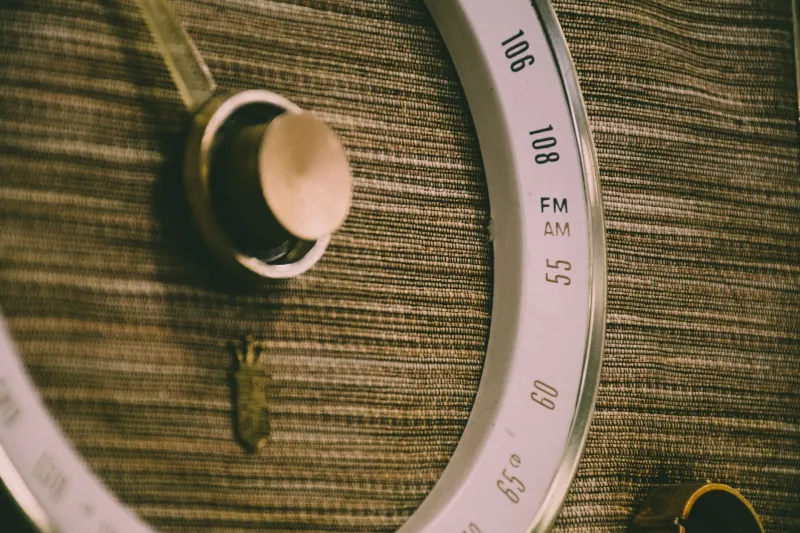
There is a moment, somewhere past one in the morning, when the AM dial stops belonging to the living. The clear-channel stations—WOGL out of Philadelphia, KFI grinding through the Los Angeles smog, WGN holding court over the flat dark of Illinois—begin to bleed into one another. A preacher in Tennessee overlaps with a cattle report from Nebraska. A voice you cannot place reads numbers you cannot decipher. The Federal Communications Commission calls this skip propagation. Listeners in farmhouses and motel rooms across the country have always called it something else.
Horror fiction has claimed the haunted house, the cursed forest, the corrupted videotape. It has largely ignored the most genuinely haunted technology America ever built: the amplitude modulation band, and the strange congregation of voices that occupies it when the sun goes down.
A Medium Already halfway to the Grave
Every ghost story depends on liminality—on thresholds, on things caught between states. AM radio after midnight is liminality made audible. The signal does not simply travel; it bounces off the ionosphere like a voice thrown against a ceiling, returning distorted, delayed, from a thousand miles away. A listener in rural Montana may hear a station licensed to New Orleans more clearly than the local transmitter twenty miles down the road. The dead of the dial are, quite literally, voices displaced from their bodies—their home frequencies, their home towns, their intended audiences.
And the medium is dying, which deepens the atmosphere. Each year, more stations go silent, surrender their licenses, or automate themselves into voiceless repeaters. What remains is a soundscape of abandonment punctuated by survivor broadcasts: late-night call-in shows where insomniacs confess to strangers, syndicated conspiracy programs, preachers promising the end, and—on certain frequencies—nothing at all but a carrier wave humming like a held breath.
Writers should understand what they have here. This is not nostalgia. This is a setting with dread built into its physics.
The Craft of Dialogue That Bleeds Through Static
Radio horror fails most often when the writer forgets the medium. A transcript of a late-night broadcast should not read like clean conversation. It should read like an artifact—damaged in transit.
Consider these techniques:
Interrupt the speaker with the medium, not the plot. Amateur radio dialogue cuts characters off at dramatic moments. Resist that. Let the static do the cutting. A host asking a caller where she's calling from, and the answer arriving as a hiss with one legible word—underneath—is more frightening than a scripted interruption, because it mimics how interference actually behaves: indifferent, unhelpful, and oddly selective.
Let repetition stand in for clarity. Real callers on graveyard-shift programs repeat themselves. "You hear me? You hear me okay?" Repetition reads as nervousness, but on the page it also reads as ritual—an incantation trying to punch through. Use it sparingly, then let a single clean sentence land like a dropped glass.
Withhold the call letters. A station that identifies itself grounds the story; a station that never does unmoors it. If your fictional broadcast has no sponsor, no frequency, no city of license, the reader's internal map of America develops a hole in it. That hole is where the dread pools.
Use the phone delay. Anyone who has called into a broadcast knows the half-second lag between host and caller—the awkward overlaps, the dead air where a person is thinking three hundred miles away. In fiction, that delay becomes uncanny when the caller answers questions a half-second before they are asked.
The Real Broadcasts That Wrote Themselves
No invention is required to find material here; the band has supplied its own nightmares for decades. The most famous is the UVB-76 buzzer—a shortwave Russian station that has transmitted a monotonous tone since the 1970s, interrupted only occasionally by a voice reading names and numbers. Its purpose has never been officially confirmed. American listeners pulling it in on the East Coast in the small hours describe the experience as being read a lullaby by something with no face.
Closer to home: the so-called numbers stations of the Cold War era, many operated by intelligence services, read strings of figures in flat, feminine or childlike voices to agents presumed to be listening somewhere in the dark. Several still broadcast. The Conet Project, a compilation of recordings released in the late 1990s, preserved them, and generations of horror composers have sampled them since.
And there is the indigenous American genre: the overnight call-in program. Shows like the long-running Coast to Coast AM built an empire on callers describing shadows at the foot of the bed and hums under the floorboards. However skeptical the host, the format itself—the lone voice, the screened calls, the hour when no one is awake to contradict anyone—is a haunted house with a transmitter.
A Listener's Field Notes
For writers who want to research by ear, a short and deliberately unsettling syllabus:
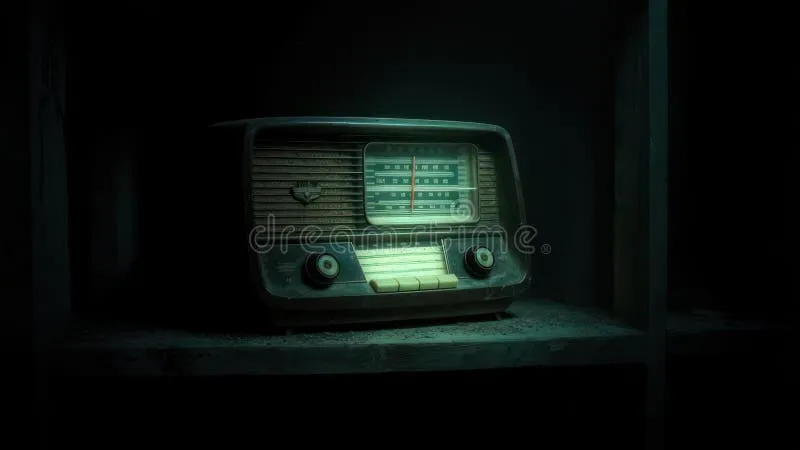
- A portable AM receiver, after midnight. No app reproduces skywave drift. An inexpensive battery radio, tuned slowly across the band from a darkened room, is the single best research tool available. Note what you hear and what you almost hear.
- The Conet Project recordings, widely available online, for the cadence of numbers stations—the flatness that makes ordinary numerals sound like a summoning.
- Archived overnight talk radio from the 1990s, much of it preserved by hobbyists, for the rhythm of real late-night callers: the pauses, the apologies, the sudden confidences offered to strangers.
- A clear-channel station at distance. Find a frequency carrying a signal from a thousand miles away and listen to how the announcer's voice arrives—slightly smeared, occasionally doubled, as though a second, identical person were standing just behind the first.
The Dial Is Still Open
The tools of horror evolve; the fears beneath them do not. The haunted television set gave way to the cursed file, the haunted phone line to the corrupted voicemail. But the AM band offers something none of its successors can: a signal that is genuinely, physically unreliable—voices that arrive out of order, from the wrong places, addressed to no one.
The next story you write does not need a mansion or a moor. It needs a kitchen radio, a kitchen light, and a caller who says, just before the static swallows her, that she can hear you breathing from where she is standing.
Turn the dial slowly. Somewhere at the end of it, something has been waiting for the audience to thin out.