The Receiver Left Off the Hook: Crafting the Dead Payphone as a Confessional Without a Priest
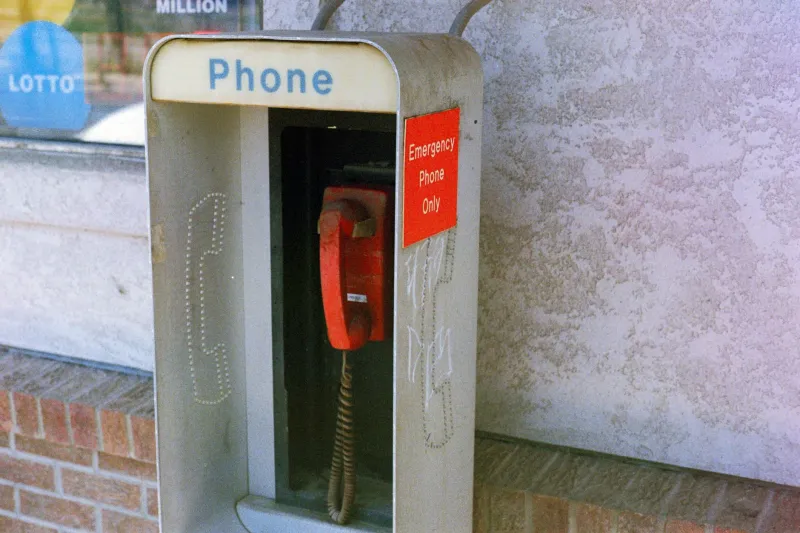
There is a particular silence inside a dead payphone. It is not the clean silence of a room without sound, but the silence of a machine that once answered and no longer does. The receiver hangs, or does not hang; the cord loops like a question mark; the instructions behind clouded plastic promise a directory, an operator, a way through. None of it works. For the horror writer, that failure is the point. The payphone is a confessional without a priest, a threshold built for connection and abandoned at the exact moment connection became ordinary.
The Booth as Architecture of Exposure
A payphone booth is a small building with a large vulnerability. It offers shelter from rain and wind, but its glass, its open sides, and its position at the edge of a parking lot or county road leave the caller exposed. That contradiction is useful. The writer can place a character inside a space that feels enclosed and watched at once. In the American landscape, the booth often stands near a gas station that has gone dark, a grain elevator, a courthouse square, or a county line where the road narrows and the fields begin. It is a landmark of transit, not destination. People arrive there because they are leaving somewhere else.
When the service is cut, the booth does not become empty. It becomes a container for the act of calling. The writer should treat it as a room with a single purpose that has been revoked. The handset, the keypad, the coin slot, the metal shelf, the printed instructions: each is a relic of a ritual. The horror does not come from a monster in the booth. It comes from the sense that the ritual is still being performed by someone who has not been told the service ended.
The Receiver Off the Hook
The most potent image is the receiver left off the hook. It implies interruption, or refusal, or a conversation that continues without a second party. A character who finds it may lift the receiver and hear nothing, or may hear the faint electricity of a line that should be dead. The writer must decide what the silence means. Is it absence, or is it attention? A dead line that produces a dial tone is a small impossibility, and small impossibilities are often more frightening than grand ones.
The off-hook receiver also creates a problem of etiquette. In a working phone, the receiver is held to the ear and mouth; it is intimate. In a dead phone, it becomes a prop that suggests someone was speaking and then stopped. The writer can use that suggestion without explanation. A character might replace the receiver and feel that they have interrupted something. They might leave it off the hook again, as if restoring a sacred disorder. The gesture matters more than the sound.
What the Coin Return Gives Back
The coin return is the booth’s smallest altar. It is designed to return what was not accepted. In a dead payphone, it can return something else: a bent washer, a blank slug, a coin from a year the character cannot place, a folded strip of paper with a number that has too many digits. The object should be specific and modest. A handful of gold coins would break the mood. A single dime with a hole drilled through it will do more work.
The coin return also allows the writer to introduce evidence without a witness. The object is found, not delivered. It suggests a transaction that occurred off the page. The character must decide whether to keep it, spend it, or leave it. That decision can reveal character more efficiently than dialogue. In horror, the coin return is a promise that the machine has a secret economy, and that the character has just been given change from a currency they do not understand.
The Instructions for Calls That Cannot Be Placed
The faded instructions are a form of scripture. They tell the caller how to make a local call, a long-distance call, an emergency call, a collect call. They list rates and dialing patterns that no longer apply. The writer can use these instructions as a kind of liturgy. A character reads them aloud. A character follows them exactly, even though the keypad is dead. A character notices that one line has been scratched out or rewritten in a hand that does not match the printer.
The instructions also provide a historical anchor. The Bell System logo, the promise of an operator, the emergency numbers that predate 911: these details place the booth in a specific American past without turning the story into a museum display. The point is not nostalgia. The point is that the instructions describe a world that was once functional and is now a set of directions for the impossible.
Craft Notes for the Confessional Scene
First, decide what confession the booth is built to receive. A payphone is public, but a confession is private. The tension lies in that mismatch. The character may speak into a dead receiver because it is the only listener available, or because it is the only listener they can bear. Second, control the sound. A dead payphone should not be noisy. The wind, the distant traffic, the hum of a failing streetlight, the click of the receiver against the cradle: these are enough. Third, avoid the temptation to explain the supernatural. The booth works best when it remains a machine that should be inert and is not.
Finally, remember that the payphone is a threshold object. It marks the edge of a road, the edge of a town, the edge of a life. The character who steps into it is already between places. The horror is not that the call cannot be completed. The horror is that someone, somewhere, may still be trying to answer.