The Street That Returns to Itself: Crafting the Cul-de-Sac as a Suburban Oubliette
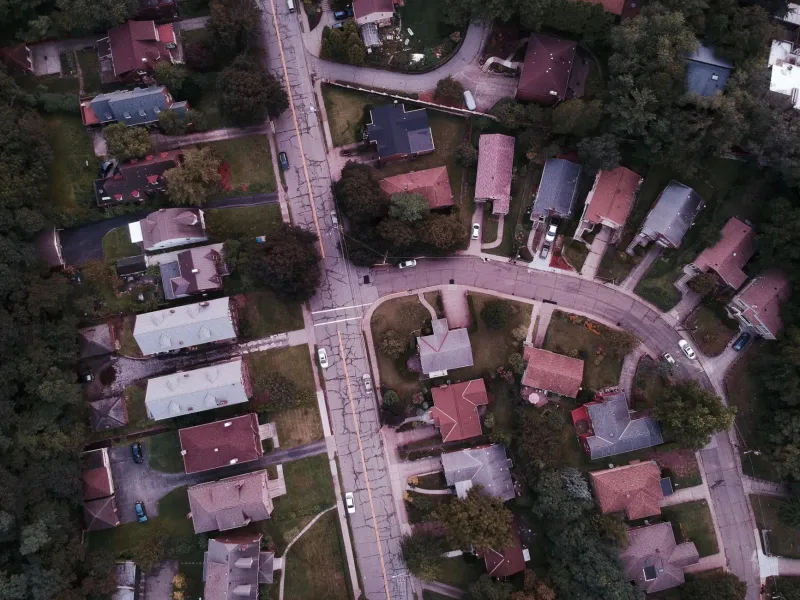
The cul-de-sac is sold as a kindness. It slows traffic, shelters children, and gathers neighbors into a tidy pocket of American suburbia. On a plat map it looks like a protected cell: one mouth, many windows, no reason for strangers to pass through. That is also a description of a trap. For writers of dark fiction, the cul-de-sac is not merely a setting. It is a narrative machine, and its central promise—safety—is the same promise that makes it so usefully claustrophobic.
The Circle as Narrative Seal
A straight street implies transit. It suggests origin, destination, and the possibility of leaving. A loop implies return. The character who walks the cul-de-sac does not move outward; the character moves around and arrives back at the same curb, the same mailbox, the same pale garage door. This is the first craft lesson of the form: geometry can perform the work of plot. No supernatural force is required to make a neighborhood feel sealed. The street itself has already been designed as a closed circuit.
Writers should treat the circular street as a stage with no wings. Every exit is visible from every window. Every arrival is observed. Every departure must pass the same mouth of the loop, which means departure is never private. In fiction, this produces a specific kind of pressure: the sense that a character is not being chased but contained. The horror is not that something follows the protagonist home. The horror is that home and street have become the same enclosure.
The Absence of Through-Traffic
A cul-de-sac is defined by what it refuses. Through-traffic is diverted elsewhere. Delivery trucks turn around. Strangers have no reason to appear. In realistic terms, this is a feature. In gothic terms, it is an absence that can be made audible. The writer can build dread from the sound of a street that hears only its own residents: the recycling bin dragged to the curb, the garage door rattling down, the distant hum of a highway that belongs to another world.
This absence should not be filled too quickly. A monster at the mouth of the cul-de-sac can release tension; a monster that never arrives can sustain it. The craft move is to let the missing traffic become a character. The empty street at dusk, the basketball hoop without players, the stop sign facing no cross street—these are negative spaces. They ask the reader to supply the reason for the silence. The reader will usually supply something worse than the writer could describe.
Facades and the Tyranny of Sameness
The cul-de-sac often arrives with a palette: beige, taupe, slate, cream. Its houses may vary in detail, but they share a grammar. The same garage dominates the same facade. The same lawn slopes toward the same sidewalk. In horror fiction, this repetition can be used as a slow erosion of identity. Which house is which? Which window belongs to the narrator? The reader begins to suspect that the street is not a collection of homes but a single home repeated until it becomes a verdict.
Writers should be careful not to confuse sameness with blandness. The identical facade is not empty; it is coercive. It implies rules. It implies an association, a covenant, a standard. The dread comes from the reader's understanding that a place so carefully regulated must have a place for deviations, and that the place may be the basement, the attic, the locked room, or the neighbor who never opens the blinds. Suburban fiction has long understood this. Ira Levin's The Stepford Wives turns the planned community into a machine of replacement. Jeffrey Eugenides's The Virgin Suicides encloses a family within the watchful geometry of a suburban street. Ray Bradbury's 'The Veldt' makes the family home a nursery that has learned to want. None of these works need a cul-de-sac on the page to teach the lesson, but the cul-de-sac concentrates it.
Dread Without a Monster
A monster explains too much. The cul-de-sac is most effective when the writer withholds explanation and allows the setting to accuse. The streetlight that clicks on at the same hour. The sprinkler that starts after midnight. The neighbor who waves from the driveway but never crosses the lawn. These details do not prove a haunting. They suggest a system. The reader begins to suspect that the street has rules, and that the protagonist has already broken one by noticing.
This is where gothic poetry can be especially useful. Poetry does not need to resolve the loop. A poem can repeat the image of the returning curb, the dead-end sign, the car that turns around at the center and drives back out. The repetition becomes incantatory. The poem does not ask who is trapped; it asks what the trapping feels like. Fiction can then follow with character, dialogue, and consequence.
A Writing Exercise: The Loop That Returns
Write a scene of 500 to 800 words in which a character walks the cul-de-sac at night. Impose three rules. First, no supernatural event may occur. Second, the character must pass the same three landmarks twice, and the second pass must feel different. Third, the scene must end with a line that implies the character cannot leave, without stating it directly. Use one sound, one smell, and one sight tied specifically to the street's circular shape. When the draft is finished, remove any sentence that explains the dread. Let the curb, the garage door, and the absent traffic do the work.
The cul-de-sac is not frightening because it is strange. It is frightening because it is familiar and closed. It was built to keep the world out, and in the right story it keeps everything else in. The writer's task is not to add a monster to the loop. The task is to notice that the loop was already a monster, dressed in siding and landscaping, waiting for someone to walk it after dark.