The Tongue Remembers: Why the Ghost Story Was Never Meant to Be Read Alone
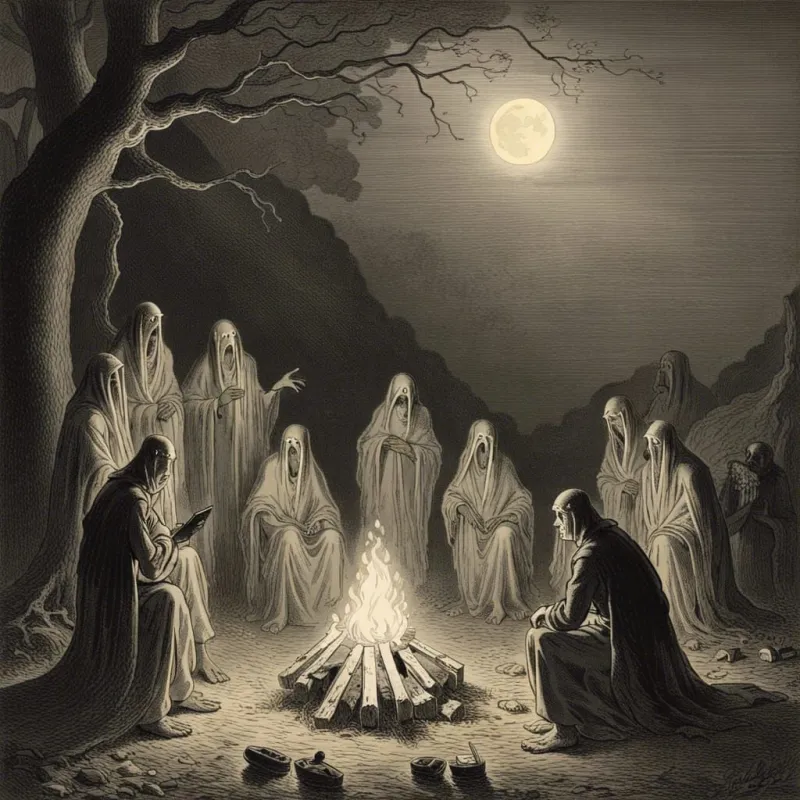
Photo: people telling ghost stories around fireplace candlelight dark room, via images.nightcafe.studio
There is a particular silence that falls in a room just before a story begins. Not the silence of reading — that silence is private, porous, easily broken by a kettle or a phone. We mean the other kind: the hush of several people agreeing, without a word, to be afraid together.
That silence is becoming rare. The ghost story, for most of its history, was a spoken thing — passed across firelight, over supper tables, on porches in the humid dark of an American August. Today it arrives mostly as pixels: a film queued at midnight, a creepypasta scrolled in isolation. Something is lost in the translation. Not the fear itself, but the communion of it.
The Architecture of a Voice
Psychologists who study narrative have long noted that oral storytelling engages listeners differently than text. A voice carries tremor, hesitation, timing. The teller can slow down at the exact moment a reader would skim ahead. Eye contact makes the impossible feel confided rather than narrated.
There is also the matter of the body. A spoken ghost story happens in a shared space — the wind at the window is part of the performance, whether the teller wants it or not. Folklorists call this contextual haunting: the tale borrows the room it is told in. Read alone, "and then the footsteps stopped outside the door" is a sentence. Spoken aloud, with the furnace ticking in the wall behind you, it is a threat.
Keepers of the Flame
Across the country, a handful of enthusiasts are working to keep the tradition breathing. In rural Ohio, a librarian hosts an annual "Lights Out" evening each October, where the stacks go dark and attendees pass a single lantern while stories travel the circle. In New Orleans, professional storytellers lead late-night walking tours that end, deliberately, in a courtyard where the final tale is told in near-total darkness.
What these practitioners share is a conviction that the ghost story is a craft with rules — rules the page has let us forget. Among them:
- Brevity is mercy. A spoken tale should end before the listener wants it to. Fifteen minutes is a ceiling, not a floor.
- The pause is the punch. Silence, held long enough, does the work a paragraph of description cannot.
- Localize relentlessly. A ghost on your street, in that diner off the interstate, outperforms any Transylvanian castle. The listener must be able to walk home past the haunting.
- Never explain. On the page, ambiguity can feel like a dodge. In the voice, it feels like mercy — or a dare.
A Practical Craft for the Spoken Tale
If you wish to tell rather than write, begin by composing aloud. Writers draft with the eye; oral storytellers must draft with the ear. Record yourself. Listen for the places your voice hurries — those are the places your listeners will too.
Structure your tale in three movements: the ordinary (ground us in a place we recognize), the wrongness (one detail that refuses to behave), and the turn (an ending that recontextualizes everything, delivered in a lowered voice). Skip the backstory. Ghosts told aloud do not need genealogies.
Finally, respect the venue. A fireside tale wants a small circle, low light, and no interruptions. Turn the phones off — not to silence, but off. The dark should have no exceptions.
Why It Matters
The screen shows us horror; the voice makes us host it. When a story is spoken into a shared dark, every listener becomes a participant in the haunting, and every creak of the house afterward becomes an echo of the tale. That is the difference between consuming fear and keeping it.
The tradition survives wherever someone is willing to lower the lights, lower the voice, and begin: "This happened, they say, not far from here."
The ghosts, it turns out, were never in the pages. They were in the pause between the sentences — waiting for someone to speak.