Timber and Tremor: How the American House Learned to Haunt Its Own Stories
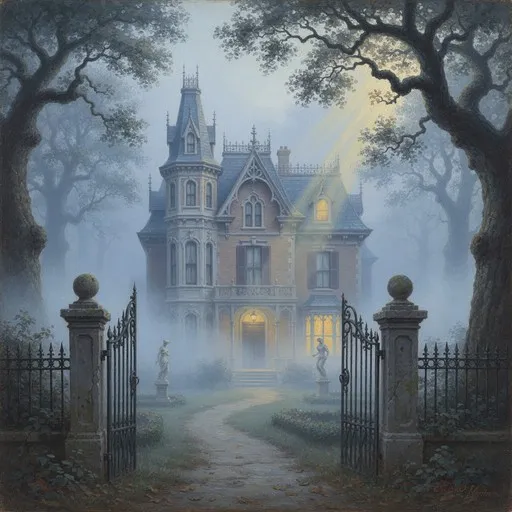
Photo: abandoned victorian mansion at dusk fog gothic, via images.stockcake.com
There is a peculiar American habit of blaming the house. Not the killer, not the curse, not even the family that raised its children within those walls — the house itself. We give it a pulse, a temperament, a slow and patient malice. The convention is so old it feels natural, but it is anything but. It is a deliberate act of craft, and understanding how architecture became a character is one of the most useful lessons a dark fiction writer can absorb.
The Blueprint of Dread
Poe did not invent the haunted house, but he gave it its American grammar. The House of Usher cracks along fissures that mirror the fracturing mind inside it — architecture as symptom, as diagnosis. That move, making the building a physical expression of interior ruin, is the seed of everything from Shirley Jackson's Hill House to the shingled monstrosities of modern literary horror.
Jackson understood something Poe only implied: the house does not merely reflect its inhabitants. It recruits them. "Whatever walked there, walked alone," she warns in the opening line of The Haunting of Hill House, and the genius of the novel is that the reader can never confirm whether the house generates its horrors or simply amplifies the fragility already sleeping in its guest rooms. Ambiguity is load-bearing in Gothic fiction. Remove it, and the whole structure collapses into a mere ghost story.
Why America Builds Its Haunts Differently
European Gothic fiction inherited its castles — ancient, feudal, layered with centuries of old-world guilt. American writers had no castles, so they built substitutes: the decaying Southern plantation, the shuttered New England farmhouse, the abandoned asylum on the hill outside a rust-belt town. These are not just settings; they are arguments about history.
The plantation house in Southern Gothic fiction — think Faulkner's crumbling Sutpen's Hundred — carries the weight of inherited sin. The house rots because the moral foundation was rotten from the first brick. Meanwhile, the New England variety, from Hawthorne's House of the Seven Gables onward, haunts through lineage: the sins of the fathers pressing down on descendants who never asked for the inheritance.
This is why the haunted house resonates so deeply with American readers. We are a nation famously obsessed with self-invention, with fresh starts. The haunted house is the perfect antagonist for that fantasy, because it insists that nothing is ever truly new. The past is in the walls. It is in the foundation. You can renovate the kitchen; you cannot renovate history.
Technique: Making the House a Character
Writers hoping to work in this tradition should study three techniques that recur across the canon:
The house as witness. Give the building a memory. In Sarah Waters' The Little Stranger — a British novel that American readers embraced precisely because it understands our idiom — the decay of Hundreds Hall is chronicled with the loving attention of a family album. Every crack is a date. Every damp patch, a diagnosis.
The house as trap. Mark Z. Danielewski's House of Leaves weaponizes architecture literally, its interior spaces refusing to obey exterior measurements. The lesson: dread intensifies when geometry itself turns hostile. The reader's spatial reasoning — their most basic trust in the world — becomes unreliable.
The house as inheritance. Contemporary horror has leaned hard into this. In works like Silvia Moreno-Garcia's Mexican Gothic and the runaway success of Home Before Dark by Riley Sager, the house is a bequest nobody wants, a legacy written in wallpaper and water damage. The horror is not that the house is evil, but that it is yours.
The Reader in the Dark
There is a final reason American fiction keeps returning to the haunted house, and it belongs to the reader rather than the writer. Everyone has stood in an empty room at night and felt it — the sensation of being observed by something that has no eyes. The haunted house story takes that universal, private shiver and gives it a floor plan. It tells us our fear has an address.
And when the last page closes and the house falls — Usher into the tarn, Hill House into its collapse — what lingers is not relief but recognition. We know the house is not gone. Houses like that are never gone. They simply wait for the next family foolish enough to call them home.